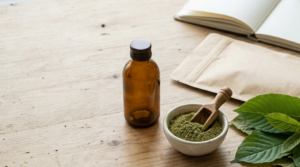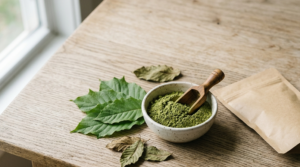
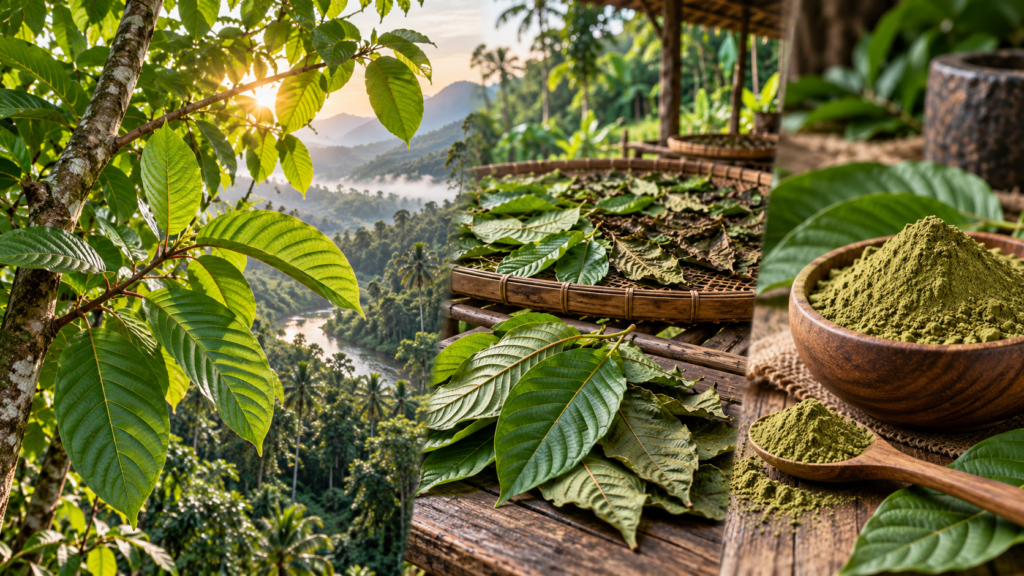
Every bag of kratom powder starts as a leaf on a tropical tree, often thousands of miles away. Between that tree and the finished product sits a supply chain of farmers, collectors, dryers and millers, most of them in Southeast Asia. Each step shapes what ends up in the bag.
This guide follows that journey from start to finish. We answer two questions people search for most: where does kratom come from, and how is kratom made. We also explain why the newer “7-OH” products on store shelves are a very different thing from the natural leaf, and why regulators now treat them separately.
The details below draw on university extension research, peer-reviewed science writing and U.S. government sources, all listed at the end.
Where Does Kratom Come From?
Kratom comes from Mitragyna speciosa, a tropical evergreen tree in the coffee family, Rubiaceae. According to the University of Florida IFAS Extension, the tree is native to central and southern Thailand, northern peninsular Malaysia, Sumatra, Borneo, the Philippines and New Guinea. It has also been reported in Vietnam and Myanmar.
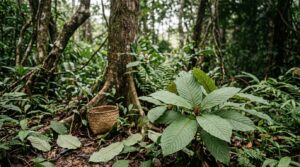
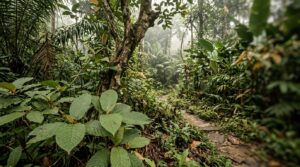
In the wild, kratom grows in tropical freshwater swamps and wetlands. These sites stay waterlogged for eight to ten months of the year. Given that habitat, the tree can reach about 80 feet tall and 15 feet wide. Cultivated trees are usually kept to 15 to 30 feet.
What the tree looks like
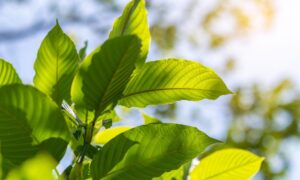
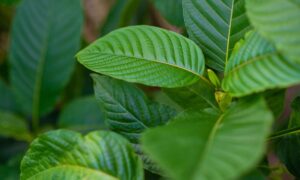
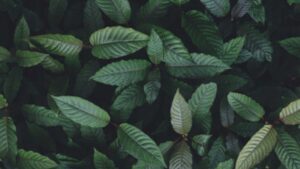
The useful part of the kratom tree is its leaf. Mature leaves measure roughly 6 to 8 inches long and 3 to 5 inches wide. They grow in opposite pairs and carry 12 to 15 pairs of veins. Those veins may be red, white or green, which is the origin of the “vein color” labels used in the trade.
The tree also flowers. Each round flower head holds 80 to 100 small flowers, which produce tiny winged seeds only 1 to 2 mm long. Wind and water carry them away.
A long local history
Kratom is not new to the region. The DEA’s drug fact sheet lists local names such as thang, kakuam, thom, ketum and biak. As ASBMB Today notes, people in Malaysia, Thailand and Indonesia have used the leaves for centuries. Laborers chewed fresh leaves or brewed them as tea. That traditional, whole-leaf use is the baseline against which modern products should be judged.
Cultivation in Southeast Asia
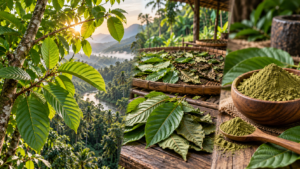
Kratom thrives where it is warm, humid and wet all year. That is why nearly all commercial leaves still come from Southeast Asia, with Indonesia’s islands, especially Borneo and Sumatra, widely reported as the main export source.
The climate kratom needs
UF/IFAS researchers give a clear picture of the tree’s comfort zone:
| Factor | Preferred range |
|---|---|
| Daytime temperature | 73–86°F (23–30°C) |
| Night temperature | 59–68°F (15–20°C) |
| Humidity | Above 60% |
| Light | Moderate to low, like a forest understory |
| Soil | Rich, organic and consistently moist |
| Outdoor zones (U.S.) | USDA hardiness zones 10a–11b |
Growth slows below about 68°F, and cold damage shows up as red spots on the leaves. The tree tolerates waterlogged ground, which suits the river banks and lowland swamps where farmers often plant it.
From wild trees to planted groves
Some leaves are still gathered from wild or semi-wild trees along rivers and forest edges. More and more comes from planted groves, often on smallholder farms. In field production, UF/IFAS reports that trees are usually spaced less than 10 feet apart, giving roughly 1,000 to 2,000 plants per acre.
New trees start in one of two ways:
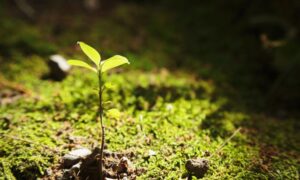
- Seeds. Sown on peat-based media, they germinate in about 8 to 13 days. They need light and warmth, around 26–28°C.
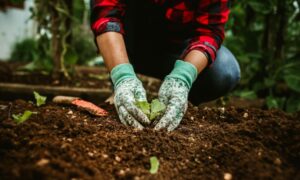
- Stem cuttings. Growers take 6 to 7 inch cuttings from below the growing tip. With rooting hormone, roots form in 4 to 6 weeks.
Cuttings are popular because they copy the parent tree exactly. That helps a farm keep a consistent leaf profile from season to season.
Pests and care
In the field, kratom faces aphids, spider mites, beetles, caterpillars and snails. Farmers generally rely on natural predators, with chemical controls rotated when needed. A balanced, slow-release fertilizer helps trees on poorer soils. Healthy trees matter, because stressed or damaged leaves can change the final product.
Harvesting: Picking the Right Leaf
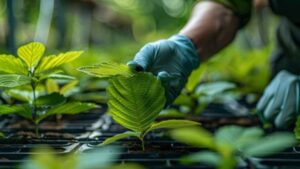
Kratom is harvested by hand. According to UF/IFAS, farmers in Southeast Asia pick leaves about every 50 days, or several times a year. Because the tree is evergreen, a healthy grove can supply leaves year-round.
Why hand-picking matters
Pickers choose leaves one by one. They look at size, maturity and vein color. Mature, full-sized leaves are the usual target, since the leaf is where the alkaloids concentrate. UF/IFAS notes that leaves hold the highest levels, stipules (small leaf-like structures at the stem) hold useful amounts, and stems and roots add very little.
That is one reason quality sellers talk about “stem and vein removal.” Stems add bulk without adding much of the active chemistry.
What vein color really means
Markets sort kratom into red, white and green vein types. The color is real: it is visible in the leaf’s midrib and veins. But vein color is only part of the story. Leaf age, growing conditions and, above all, how the leaf is dried can all shift its chemistry. Two “green” batches from different farms may differ more than a red and a green from the same farm.
From farmer to collector
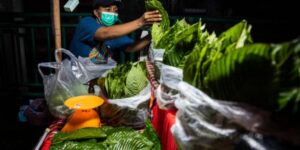
After picking, leaves move fast. Smallholders typically sell fresh leaf to local collectors or bring it to a processing site. Fresh leaves bruise and spoil in heat and humidity, so the time between picking and drying is one of the most important links in the chain.
How Is Kratom Made? From Fresh Leaf to Fine Powder
So, how is kratom made? The short answer: it is dried and ground. The longer answer is a sequence of steps, each of which can raise or lower quality. The diagram below maps the full chain from tree to finished product.
Step 1: Sorting and cleaning
Fresh leaves are sorted to remove damaged, diseased or off-color leaves, twigs and debris. Some producers wash leaves at this stage. Careful sorting is the first defense against contamination later on.
Step 2: Drying
Drying is the most important step in turning leaf into powder. UF/IFAS describes two main methods:
- Indoor drying on racks, with fans moving air over the leaves
- Outdoor drying in direct sunlight
Many producers combine the two, for example starting indoors and finishing in the sun. The goal is to remove moisture fast enough to prevent mold, without degrading the leaf. Indoor drying gives more control over heat, light and cleanliness. Sun drying is cheaper but more exposed to dust, insects and weather.
Drying does more than preserve the leaf. UF/IFAS notes that postharvest conditions alter the alkaloid profile. Heat, light, time and airflow all influence the final chemistry. This is why many in the trade link vein strains as much to drying style as to the tree itself. Some producers also let leaves rest or “ferment” in bags before final drying, a practice often associated with darker, red-labeled products.
Step 3: De-stemming and de-veining
Once dry and brittle, the leaves are separated from stems. UF/IFAS reports that some producers also remove the main leaf veins. This concentrates the leaf tissue and gives a smoother, finer powder.
Step 4: Grinding
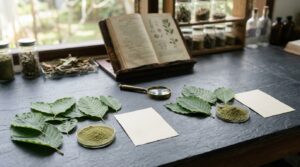
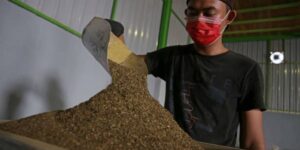
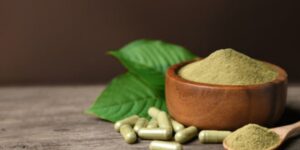
The dried leaf is milled into either coarse crumbs or fine powder. Crumbs are often used for tea. Fine powder is the familiar form sold in pouches and capsules. Industrial mills grind large batches quickly, while smaller operations may use simpler grinders.
Step 5: Sieving, testing and packing
The powder is sifted through mesh screens to get an even texture. Oversized particles go back for regrinding. Reputable exporters then batch, test and pack the product in sealed bags. From there it moves to exporters, importers, and finally the retailers who sell it as powder, capsules, tablets or tea, the forms the DEA lists.
Inside the Leaf: Mitragynine and 7-Hydroxymitragynine
Why does any of this processing matter? Because of what the leaf contains. ASBMB Today reports that kratom leaves contain at least 37 different alkaloids. Two get most of the attention:
- Mitragynine, the leaf’s main alkaloid, first isolated in 1921
- 7-hydroxymitragynine (7-OH), an oxidized form of mitragynine
UF/IFAS notes that mitragynine makes up anywhere from 0.7% to 38.7% of the leaf’s total alkaloids, depending on the plant and conditions. Other alkaloids, such as speciogynine and paynantheine, together account for about 15%. 7-OH, by contrast, is present in natural leaves only in trace amounts. UF/IFAS describes it as a metabolite of mitragynine, meaning the body can also make it from mitragynine after the leaf is consumed.
How these compounds act
Both compounds interact with the brain’s opioid receptors, but not in the same way. ASBMB Today explains that both are partial agonists at mu-opioid receptors. They activate those receptors less fully than morphine does. Researchers have described mitragynine as working a bit like buprenorphine light.
The two compounds do not behave alike, though. In animal studies cited by ASBMB Today, rats would self-administer 7-OH but not mitragynine. That suggests 7-OH carries a greater potential for misuse. Keep that point in mind for the next section.
Where 7-OH Products Differ From Natural Leaf
This is the biggest break in the supply chain. Everything described so far, from picking to grinding, keeps the leaf whole. It simply dries and mills it. 7-OH products take a different path entirely.
A different product, not a stronger strain
7-OH products are sold as tablets, gummies, shots and similar formats. They are not made by drying and grinding leaves. Instead, manufacturers isolate or chemically produce 7-hydroxymitragynine, often by converting mitragynine in a lab, and then sell it in concentrated doses. The result contains far more 7-OH than any natural leaf would.
The U.S. Food and Drug Administration draws this line clearly. On July 29, 2025, the FDA recommended that 7-OH be scheduled as a controlled substance. The agency described 7-OH as a concentrated byproduct of the kratom plant and said its action targets these products, not natural kratom leaf. FDA Commissioner Marty Makary put it bluntly: “7-OH is an opioid that can be more potent than morphine.”
Leaf vs. 7-OH at a glance
| Feature | Natural kratom leaf | 7-OH products |
|---|---|---|
| How it is made | Dried, de-stemmed and ground leaf | Isolated or lab-converted alkaloid |
| Main alkaloid | Mitragynine, with dozens of others | 7-hydroxymitragynine, concentrated |
| 7-OH content | Trace amounts | Engineered to be high |
| Typical forms | Powder, crumbs, capsules, tea | Tablets, gummies, shots |
| Regulatory view | Not federally controlled; state rules vary | FDA recommended scheduling in 2025 |
The regulatory picture
Natural kratom is not controlled under the federal Controlled Substances Act, according to the DEA. However, the FDA has not approved it for any medical use, and the DEA lists it as a “Drug and Chemical of Concern.” The FDA also maintains Import Alert 54-15 on kratom.
States set their own rules. UF/IFAS lists Alabama, Arkansas, Indiana, Rhode Island, Vermont and Wisconsin as states where kratom is illegal. Several others have passed Kratom Consumer Protection Acts, including Florida’s law that took effect on July 1, 2025. Laws on 7-OH are changing quickly, so readers should check current federal and state rules before buying.
Quality, Testing and Safety Along the Chain
A long supply chain has many weak points. Leaves can pick up dust, microbes or heavy metals during drying and handling. Powder can be mislabeled, blended, or cut with other substances before it reaches a shelf. And, as the 7-OH story shows, a product labeled “kratom” may not be leaf at all.
What good practice looks like
- Traceable sourcing. The seller can name the region and, ideally, the farm or collector.
- Clean drying. Indoor or covered drying reduces exposure to dirt and pests.
- Third-party lab testing. Batches are tested for alkaloid content, microbes and heavy metals.
- Clear labeling. Labels show alkaloid levels and state plainly whether a product is whole leaf or an extract.
Know the risks
Kratom is not risk-free, even in natural leaf form. The DEA lists reported effects including nausea, sweating, constipation, rapid heartbeat, vomiting and drowsiness, as well as more serious concerns such as liver toxicity and seizures.
It also states that kratom use can lead to addiction. Anyone considering kratom should speak with a healthcare provider, especially if they take other medications.
Frequently Asked Questions
Where does kratom come from?
Kratom comes from the leaves of Mitragyna speciosa, a tropical tree native to Thailand, Malaysia, Indonesia (Sumatra and Borneo), the Philippines and New Guinea.
How is kratom made?
Leaves are hand-picked, sorted, dried indoors or in the sun, stripped of stems and sometimes veins, then ground into crumbs or fine powder and sieved before packing.
Does vein color come from the tree or the processing?
Both. Vein color is visible on the leaf, but drying methods and leaf maturity also shape the final product.
Is 7-OH the same as kratom?
No. 7-OH products are concentrated or lab-made forms of one alkaloid. Natural leaf contains only trace amounts of 7-OH. The FDA has treated the two very differently.
How often is kratom harvested?
In Southeast Asia, leaves are typically picked about every 50 days, or several times a year.
Final Thoughts
The journey from kratom tree to powder is simple in outline: grow, pick, dry, grind. Yet every link in that chain, from the swampy soils of Borneo to the drying racks and mills, shapes the final product.
Understanding where kratom comes from and how it is made helps readers tell whole-leaf products apart from the concentrated 7-OH items now drawing regulatory scrutiny. When in doubt, look for traceable sourcing, independent lab tests and honest labels.